Assessing your Symptoms
The Greene Climacteric Scale: putting your hormone symptoms into words
One of the hardest things about perimenopause is that it can feel like lots of apparently unrelated things are changing at once.
Sleep. Anxiety. Palpitations. Brain fog. Headaches. Mood. Hot flushes. Energy. Sex drive.
That is where the Greene Climacteric Scale (or GCS as I commonly call it) can be really useful.
What is the Greene Climacteric Scale?
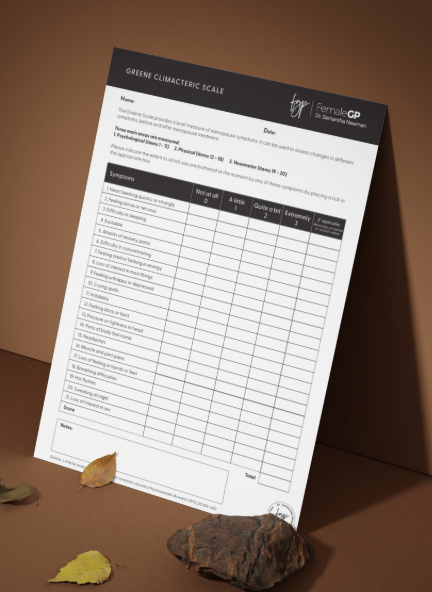
The GCS is a well-established questionnaire used to measure symptoms associated with the menopause transition.
It asks about 21 symptoms, with each rated from:
0 — not at all
to
3 — extremely
Rather than simply asking “Do you have hot flushes? ”, it looks more broadly at different groups of symptoms:
- anxiety
- low mood/depressive symptoms
- physical or somatic symptoms
- hot flushes and night sweats
- sexual interest
The psychological section can also be separated into anxiety and depression scores.
Why do I like it?
Because hormones don't only cause hot flushes.
A questionnaire like this can help you step back and see the pattern.
It can help:
- identify symptoms you hadn't connected with your hormones
- show which symptoms are bothering you most
- give you language to explain what has changed
- provide a baseline before treatment
- track whether things are actually improving
It doesn't diagnose perimenopause on its own and a high score doesn't mean that every symptom is caused by hormones.
It is a clue-gathering tool.
And sometimes seeing the clues together is much more useful than looking at each symptom separately.
But what if my periods are still regular?
This is really important.
You do not necessarily have to be skipping periods before you start experiencing perimenopausal changes.
Professor Jerilynn Prior and colleagues have particularly highlighted this very early stage of perimenopause.
They suggest that a woman in midlife who still has regular, normal-length cycles may be experiencing very early perimenopause if she develops three or more of the following:
- new heavy or longer periods
- shorter cycles — 25 days or less
- new sore, swollen or lumpy breasts
- new or increased period cramps
- new waking in the middle of the night
- new night sweats, particularly around periods
- new or markedly worse migraines
- new or increased premenstrual mood swings
- noticeable weight gain without a clear change in food intake or exercise
This framework is broader than the formal STRAW+10 staging system, which identifies the menopause transition primarily through changing menstrual-cycle patterns.
And that distinction matters.
You can have regular periods and still be experiencing meaningful hormone change.
The take-home message
A questionnaire cannot tell you why you have a symptom.
But it can help us ask a better question:
Is there a hormonal pattern here?
And once we can see the pattern, we can start working out what to do about it.
References
Greene JG. Constructing a standard climacteric scale. Maturitas. 1998;29:25–31.