Bisphosphonates - why my thinking has changed
For a long time, I was cautious about bisphosphonates.
These are medicines such as alendronate (Fosamax) and zoledronate. They slow the breakdown of bone and reduce fracture risk.
They work. We have known that for years.
But I tended to think of them as medicines for people who already had osteoporosis, had fractured, or were clearly at high risk.
Particularly with oral bisphosphonates, I was conscious of the practicalities and potential side effects: gastrointestinal irritation, the need to take them correctly, and the very rare risks of osteonecrosis of the jaw and atypical femoral fractures.
So my thinking was often:
- Monitor the bones. If they deteriorate enough, then treat.
- I am increasingly questioning that.
- Prevent the predictable loss
There is a principle we already use elsewhere in medicine:
Prevent the predictable loss rather than waiting to treat its consequences.
Steroids are a good example. Long-term systemic corticosteroids can cause rapid bone loss — estimates suggest lumbar spine bone density may fall by around 6–12% in the first year. Because we know that risk is coming, we don't necessarily wait for someone to develop osteoporosis before thinking about bone protection. We assess the risk and intervene earlier when appropriate.
Which made me think again about menopause.
Menopause is also a time of predictable accelerated bone loss.
The fastest period starts around the final menstrual period and continues into early postmenopause. Average bone loss during this phase is around 2% per year, and can be higher at the spine.
Clearly this is not the same as steroid-induced osteoporosis — steroid bone loss can be much faster.
But the principle is interesting:
If we know when bone loss is going to happen, should we always wait until it has happened before intervening?
Then came an important New Zealand study
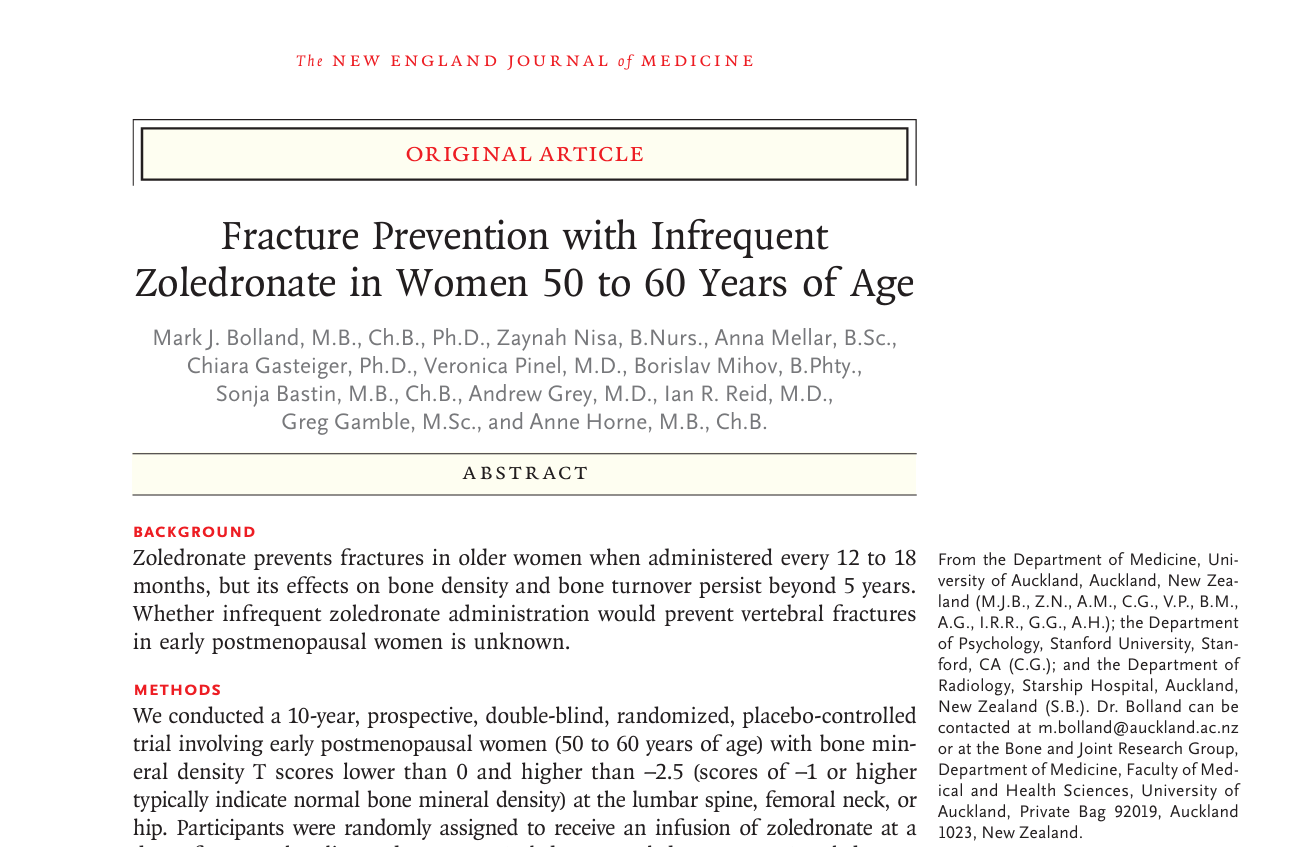
Researchers from the University of Auckland followed more than 1,000 women aged 50–60 who were early postmenopausal.
Importantly, these women did not have osteoporosis.
They received either:
• zoledronate at the beginning and again five years later
• one zoledronate infusion at the beginning
• or placebo.
They were then followed for 10 years.
The results were fascinating.
Vertebral fractures occurred in:
11.1% of women receiving placebo
6.6% after one zoledronate infusion
6.3% after two infusions five years apart.
Two infusions also reduced major osteoporotic fractures by around 40%.
Perhaps the most interesting part is how long the effect lasted.
Zoledronate binds to bone and remains biologically active for years. Even one infusion produced substantial benefits that were still apparent years later.
That does not mean everyone needs an infusion, or that one infusion every decade is now the answer.
The study was in early postmenopausal women aged 50–60, not women across the whole of perimenopause.
Bone health is also much bigger than one medication.
Resistance and weight-bearing exercise, protein, calcium, vitamin D, smoking, alcohol, medications, medical conditions and maintaining muscle all matter.
And where appropriate, menopausal hormone therapy remains a very useful way of reducing menopause-associated bone loss while also treating menopausal symptoms.
Bisphosphonates still have risks too. Kidney function, calcium and vitamin D, dental health and individual fracture risk all need to be considered.
So I am certainly not suggesting we start putting zoledronate in the water supply.
But my thinking has shifted.
Instead of only asking:
“Does this woman have osteoporosis yet?”
I increasingly want to ask:
“What is happening to her bones now, what is likely to happen over the next decade, and is there an opportunity to prevent some of that loss?”
Because perhaps bone health shouldn't always be about waiting for the DEXA scan to become bad enough.
Sometimes the better question is:
Can we prevent the predictable loss rather than waiting to treat its consequences?